Are you smart because if you can read this you are really smart.
Wow ICH cant glaube, sie lesen. Ich schätze du wirklich smart und klicken Sie bitte auf den Knopf, sagt Drücken Sie auf ihr eigenes Risiko Es hat einen Haufen von lustige Zeichen auf.

Wednesday, November 24, 2010
This is a unique and an amazing lamp .

Step by Step Up & Down Light Lamp that features:
* Adjust it to go up or down by touching it.
* Adjust the lamp brightness by touching it.
* Big color display.
* Soft light line.
So as you can see this can be a great gift were you can practically build up your own lamp. It even has a digital clock on it.This could be yours for the remarkable price of USD $30.50 It takes Power: AC 220V, 25W or Batteries: 2*AAA
Step by Step Up & Down Light Lamp that features:
* Adjust it to go up or down by touching it.
* Adjust the lamp brightness by touching it.
* Big color display.
* Soft light line.
So as you can see this can be a great gift were you can practically build up your own lamp. It even has a digital clock on it.This could be yours for the remarkable price of USD $30.50 It takes Power: AC 220V, 25W or Batteries: 2*AAA
A self-replicating 3D printer that spawns new, improved versions of itself is in development at the University of Bath in the UK.

The "self replicating rapid prototyper" or RepRap could vastly reduce the cost of 3D printers, paving the way for a future where broken objects and spare parts are simply "re-printed" at home. New and unique objects could also be created.
3D printing - also known as "rapid prototyping" - transforms a blueprint on a computer into a real object by building up a succession of layers. The material is bonded by either fusing it with a laser or by using alternating layers of glue. When it first emerged in the mid-1990s, futurists predicted that there would be a 3D printer in every home.
But they currently cost $25,000 (£13,000) and so have not caught on as a household item, says Terry Wohlers, an analyst at Wohlers Associates, a rapid prototyping consulting firm in Fort Collins, Colorado, US. Instead, they are used by industry to develop parts for devices such as aircraft engines, spaceships and hearing aids.
Plummeting prices
Now Adrian Bowyer hopes to change that by making the first 3D printer capable of fabricating copies of itself, as well as a wealth of everyday objects. He reasons that prices would plummet to around $500 if every machine was capable of building hundreds more at no cost beyond that of the raw materials.
Better still, the machines could evolve to be more efficient and develop new capabilities, says Bowyer. Once he has the software to guide the self-replicating process, he plans to make it freely available online, allowing users to contribute improvements, just like the open-source Linux computer operating system, he says.
Bowyer dreamt up the idea of the RepRap in February 2004. But now he has he figured out how to print conducting materials in three dimensions without using a laser, a key step if the machine is ever to make copies of itself.
"We are very constrained in our access to materials," he explains. They must be sturdy enough to make up the body of the machine and yet simple enough to be fabricated entirely by the machine. "We have to avoid any design needing lasers and high precision measuring systems," he explains.
Tepid metal
3D printers normally build circuits by fusing together a powdered metal with a laser. But Bowyer plans instead on using a low-melting point metal alloy of bismuth, lead, tin and cadmium that can be squirted from a heated syringe to form circuits.
Bowyer has already produced an electronic circuit by squirting the alloy inside a plastic autonomous robot, which itself was created using a commercial 3D printer. Because the heated syringe he used is very similar to the nozzle that deposits plastic layers in the printer, he envisions squirting both plastic and metal from the same nozzle in future self-replicating machines.
The machine need not be capable of assembling itself, he says, only producing all the necessary parts, with the exception of the microprocessors and the lubricating grease. These could later be added and the various parts clipped together, Bowyer says. "People are quite capable of assembling things if they want to," he adds. "I am not interested in self-assembly, just self-copying."
Whether such a machine would work has experts sharply divided. "I think Dr Bowyer's idea is very plausible," says Matt Moses, a consultant who has built a small self-replicating robot and advises NASA on research into self-replicating machines for space.
But Wohlers disagrees: "[Bowyer] is referring to something that does not exist and has not been demonstrated. Will it develop in the future? Unlikely."
He adds that even if all its components could be replicated by the machine, the concept does not make economic sense. "Many of the components could be produced much faster and cheaper by other machines," he says.
The "self replicating rapid prototyper" or RepRap could vastly reduce the cost of 3D printers, paving the way for a future where broken objects and spare parts are simply "re-printed" at home. New and unique objects could also be created.
3D printing - also known as "rapid prototyping" - transforms a blueprint on a computer into a real object by building up a succession of layers. The material is bonded by either fusing it with a laser or by using alternating layers of glue. When it first emerged in the mid-1990s, futurists predicted that there would be a 3D printer in every home.
But they currently cost $25,000 (£13,000) and so have not caught on as a household item, says Terry Wohlers, an analyst at Wohlers Associates, a rapid prototyping consulting firm in Fort Collins, Colorado, US. Instead, they are used by industry to develop parts for devices such as aircraft engines, spaceships and hearing aids.
Plummeting prices
Now Adrian Bowyer hopes to change that by making the first 3D printer capable of fabricating copies of itself, as well as a wealth of everyday objects. He reasons that prices would plummet to around $500 if every machine was capable of building hundreds more at no cost beyond that of the raw materials.
Better still, the machines could evolve to be more efficient and develop new capabilities, says Bowyer. Once he has the software to guide the self-replicating process, he plans to make it freely available online, allowing users to contribute improvements, just like the open-source Linux computer operating system, he says.
Bowyer dreamt up the idea of the RepRap in February 2004. But now he has he figured out how to print conducting materials in three dimensions without using a laser, a key step if the machine is ever to make copies of itself.
"We are very constrained in our access to materials," he explains. They must be sturdy enough to make up the body of the machine and yet simple enough to be fabricated entirely by the machine. "We have to avoid any design needing lasers and high precision measuring systems," he explains.
Tepid metal
3D printers normally build circuits by fusing together a powdered metal with a laser. But Bowyer plans instead on using a low-melting point metal alloy of bismuth, lead, tin and cadmium that can be squirted from a heated syringe to form circuits.
Bowyer has already produced an electronic circuit by squirting the alloy inside a plastic autonomous robot, which itself was created using a commercial 3D printer. Because the heated syringe he used is very similar to the nozzle that deposits plastic layers in the printer, he envisions squirting both plastic and metal from the same nozzle in future self-replicating machines.
The machine need not be capable of assembling itself, he says, only producing all the necessary parts, with the exception of the microprocessors and the lubricating grease. These could later be added and the various parts clipped together, Bowyer says. "People are quite capable of assembling things if they want to," he adds. "I am not interested in self-assembly, just self-copying."
Whether such a machine would work has experts sharply divided. "I think Dr Bowyer's idea is very plausible," says Matt Moses, a consultant who has built a small self-replicating robot and advises NASA on research into self-replicating machines for space.
But Wohlers disagrees: "[Bowyer] is referring to something that does not exist and has not been demonstrated. Will it develop in the future? Unlikely."
He adds that even if all its components could be replicated by the machine, the concept does not make economic sense. "Many of the components could be produced much faster and cheaper by other machines," he says.
Tuesday, November 23, 2010
Merry christmas It is
If you want we can share gifts
wmode="transparent" align="middle" type="application/x-shockwave-flash">
Christmas Gift Toy & MySpace Layouts at pYzam.com
And for all you hot shots out there who think they have the best Christmas light set up see If you compete with this
Make your own Countdown Clocks

If you want we can share gifts

wmode="transparent" align="middle" type="application/x-shockwave-flash">
Christmas Gift Toy & MySpace Layouts at pYzam.com

And for all you hot shots out there who think they have the best Christmas light set up see If you compete with this
Mark Makers Table Comes With 50 Coats Of Paint So You Can Redesign It
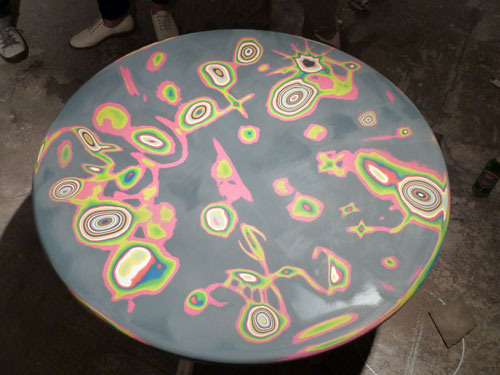
Decorating a plain table usually involves adding layers of paint on top. The Mark Makers Table, however, does it the other way around, hiding numerous layers of differently-colored paint under the single coat exterior.
Built by Ed Swan, the table starts out life in a plain shade of gray. Over use, the top color begins to chip, revealing the swath of colors lying underneath, creating a multi-colored abstract design on your tabletop.

The Mark Makers Table has 50 different layers of paint lying under the erstwhile boring finish, making for plenty of possible color combinations once you begin digging through the paint. They used ash wood and MDF to build the table, with different types of paint for coating.
Currently displayed at the Okay Studio in London, visitors are given sandpaper to leave some of their designs on it. As you can see from the pictures, the results look pretty awesome, albeit a bit chaotic.
Exhibition of the Mark Makers table will run until September 26. After that, whatever the finished result looks like will be cleaned up and applied with a clear lacquer to seal it. No word on what they're going to do with the end product, but we're guessing this can fetch a pretty penny in auction.
Decorating a plain table usually involves adding layers of paint on top. The Mark Makers Table, however, does it the other way around, hiding numerous layers of differently-colored paint under the single coat exterior.
Built by Ed Swan, the table starts out life in a plain shade of gray. Over use, the top color begins to chip, revealing the swath of colors lying underneath, creating a multi-colored abstract design on your tabletop.
The Mark Makers Table has 50 different layers of paint lying under the erstwhile boring finish, making for plenty of possible color combinations once you begin digging through the paint. They used ash wood and MDF to build the table, with different types of paint for coating.
Currently displayed at the Okay Studio in London, visitors are given sandpaper to leave some of their designs on it. As you can see from the pictures, the results look pretty awesome, albeit a bit chaotic.
Exhibition of the Mark Makers table will run until September 26. After that, whatever the finished result looks like will be cleaned up and applied with a clear lacquer to seal it. No word on what they're going to do with the end product, but we're guessing this can fetch a pretty penny in auction.


Real-life ‘Iron Man’ suits tested
By Mark Jewell - The Associated Press
Posted : Monday May 19, 2008 11:40:03 EDT
Rex Jameson bikes and swims regularly, and plays tennis and skis when time allows. But the 5-foot-11, 180-pound software engineer is lucky if he presses 200 pounds — that is, until he steps into an “exoskeleton” of aluminum and electronics that multiplies his strength and endurance as many as 20 times.
With the outfit’s claw-like metal hand extensions, he gripped a weight set’s bar at a recent demonstration and knocked off hundreds of repetitions. Once, he did 500.
“Everyone gets bored much more quickly than I get tired,” Jameson said.
Jameson — who works for robotics firm Sarcos Inc. in Salt Lake City, which is under contract with the Army — is helping assess the 150-pound suit’s viability for the soldiers of tomorrow. The suit works by sensing every movement the wearer makes and almost instantly amplifying it.
VIDEO: See a demonstration of the suit
The Army thinks soldiers may someday wear the suits in combat, but it’s focusing for now on applications such as loading cargo or repairing heavy equipment. Sarcos is developing the technology under a two-year contract worth up to $10 million, and the Army plans initial field tests next year.
Before the technology can become practical, the developers must overcome cost barriers and extend the suit’s battery life. Jameson was tethered to power cords during his demonstration because the current battery lasts just 30 minutes.
But the technology already offers evidence that robotics can amplify human muscle power in reality — not just in the realm of comic books and movies like the recently debuted “Iron Man,” about a wealthy weapons designer who builds a high-tech suit to battle bad guys.
“Everybody likes the idea of being a superhero, and this is all about expanding the capabilities of a human,” said Stephen Jacobsen, chief designer of the Sarcos suit.
The Army’s exoskeleton research dates to 1995, but has yet to yield practical suits. Sarcos’ technology sufficiently impressed Raytheon Co., however, that the Waltham, Mass.-based defense contractor bought Sarcos’ robotics business last November. Sarcos also has developed robotic dinosaurs for a Universal Studios’ “Jurassic Park” theme park ride.
Jack Obusek, a former colonel now with the Army’s Soldier Research Development and Engineering Center in the Boston suburb of Natick, foresees robot-suited soldiers unloading heavy ammunition boxes from helicopters, lugging hundreds of pounds of gear over rough terrain or even relying on the suit’s strength-enhancing capabilities to make repairs to tanks that break down in inconvenient locations.
Sarcos’ Jacobsen envisions factory workers someday using the technology to perform manual labor more easily, and firefighters more quickly carrying heavy gear up stairwells of burning buildings. Disabled people also may find uses for the technology, he said.
“We see the value being realized when these suits can be built in great numbers for both military and commercial uses, and they start coming down in cost to within the range of the price of a small car,” said Jacobsen. He declined to estimate how much the suit might cost in mass production.
But cost isn’t the only obstacle. For example, developers eventually hope to lengthen the suit’s backpack battery’s life and tinker with the suit’s design to use less energy. Meanwhile, the suit can draw power from a generator, a tank or helicopter. And there are gas engines that, while noisy, small enough to fit into the suit’s backpack.
“The power issue is probably the No. 1 challenge standing in the way of getting this thing in the field,” Obusek said.
But he said Sarcos appears to have overcome the key challenge of pairing super-fast microprocessors with sensors that detect movements by the body’s joints and transmit data about them to the suit’s internal computer.
Much as the brain sends signals to tendons to get muscles to move, the computer sends instructions to hydraulic valves. The valves mimic tendons by driving the suit’s mechanical limbs, replicating and amplifying the wearer’s movements almost instantly.
“With all the previous attempts at this technology, there has been a slight lag time between the intent of the human, and the actual movement of the machine,” Obusek said.
In the demonstration, the bulky suit slowed Jameson a bit, but he could move almost normally. When a soccer ball was thrown at him, he bounced it back off his helmeted head. He repeatedly struck a punching bag and, slowly but surely, he climbed stairs in the suit’s clunky aluminum boots.
“It feels less agile than it is,” Jameson said. “Because of the way the control laws work, it’s ever so slightly slower than I am. And because we are so in tune with our bodies’ responses, this tiny delay initially made me tense.”
Now, he’s used to it.
“I can regain my balance naturally after stumbling — something I discovered completely by accident.”
Learning was easy, he said.
“It takes no special training, beyond learning to relax and trust the robot,” he said.
DISCUSS: Soldiers of the futur
http://www.armytimes.com/news/2008/05/ap_roboticsuit_051508/

The fourth dimension !!!!!
The tesseract is to the cube as the cube is to the square. Just as the surface of the cube consists of 6 square faces, the hypersurface of the tesseract consists of 8 cubical cells. The tesseract is one of the six convex regular 4-polytopes.
A generalization of the cube to dimensions greater than three is called a "hypercube", "n-cube" or "measure polytope". The tesseract is the four-dimensional hypercube, or 4-cube.
According to the Oxford English Dictionary, the word tesseract was coined and first used in 1888 by Charles Howard Hinton in his book A New Era of Thought, from the Greek “τέσσερεις ακτίνες” (“four rays”), referring to the four lines from each vertex to other vertices. Some people have called the same figure a tetracube, and also simply a hypercube (although the term hypercube is also used with dimensions greater than 4).
Thanks to http://en.wikipedia.org/wiki/Tesseract
Monday, November 22, 2010
Subscribe to:
Comments (Atom)
music


